MyLenoma: a skin-cancer triage app in a week
2025 · Team project · University College London

The brief
Build an app that estimates skin-cancer risk from a phone photo, for people with poor access to dermatology and for high-risk users. We had one week.
What we built
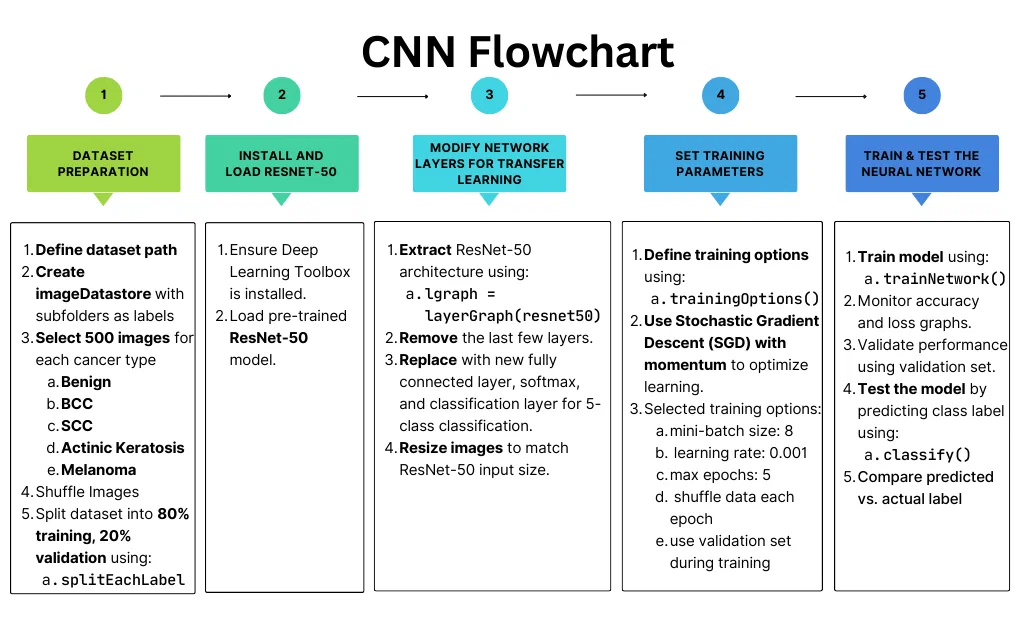
A ResNet50 retrained in MATLAB using transfer learning, with the final layers replaced by a five-neuron fully connected layer, a softmax layer and a classification layer. It sorts lesions into five classes (benign, actinic keratosis, melanoma, basal cell carcinoma and squamous cell carcinoma), which the app groups as benign, pre-cancerous or cancerous. We trained it on 2,500 images from the ISIC Archive, 500 per class.
Every prediction comes with a Grad-CAM heatmap and a confidence score, so users can see which part of the image the model used. The data sits in a two-table relational database holding logins, images and measurements. The interface has four MATLAB App Designer screens with live phone-camera capture, a retake-and-confirm step, and a measuring tool so users can track a mole’s size over time. The measuring tool is adapted from Jann5s/measuretool, an open-source MATLAB tool.
My part
I retrained the ResNet50, built the SQL database and wrote the executive summary. The summary covered target users, a feasibility, desirability and viability assessment, competitors (SkinIO, MoleMapper), the market case (99% five-year melanoma survival when caught early, 30% after it spreads, and NHS dermatology waits of about 11 weeks), the legal risk of a wrong diagnosis, and the relevant UN SDGs. We stated that we had used AI tools to help debug code.
Result
Biomedical Engineering Presentation Award for the best project in the cohort (86%).
The model’s accuracy was below what clinical use would require, which we stated in our assessment. The main limitations were the size of the training set and its bias towards fair skin. This is why each prediction is shown with a Grad-CAM heatmap and confidence score. More on this in a post on what the model taught me.